


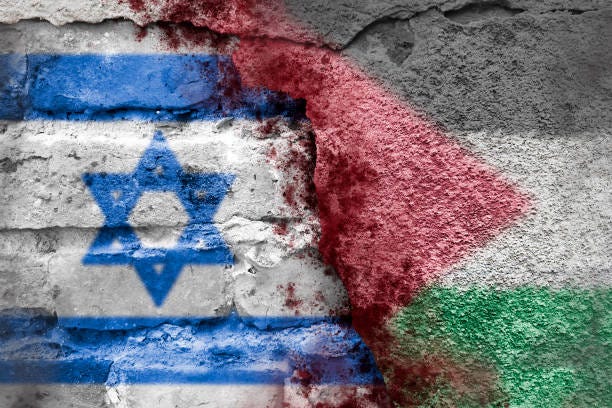
1. The Dangerous Logic of Justifying Mass Death
Two recent opinion pieces—one in The New York Times by Bret Stephens, No, Israel Is Not Committing Genocide in Gaza, the other in The Wall Street Journal by Gerard Baker, Hamas Starves Jews and Palestinians, and Israel Gets Blamed—have laid bare the moral collapse of Western commentary on Gaza. Stephens argues that Israel cannot be committing genocide because the death toll isn’t high enough. Baker claims Hamas, not Israel, is responsible for starvation and suffering, and that condemnation of Israeli actions is manipulated propaganda.
But both pieces, while different in tone, rely on the same flawed foundations:
That Palestinian suffering is tolerable if not intentional
That Israeli force is justified by Hamas’s existence
And that military dominance can be used without political vision
This is not moral clarity. It’s moral anesthesia.
2. Genocide Is About Intent, Not Body Count
Stephens asks: “If Israel’s intentions are genocidal, why hasn’t it been more methodical and deadly?”
But genocide, as defined by the UN Convention, is not about the number of deaths. It’s about intent to destroy, in whole or in part, a national, ethnic, racial, or religious group. That includes:
Killing
Inflicting conditions of life calculated to destroy
Starvation
Forcible transfer
Preventing births
You don’t need mass graves to commit genocide. Israel’s destruction of infrastructure, denial of aid, forced displacement, and blockade fit too closely to ignore. It is a systematic, targeted campaign to break people. And Israel’s conduct—destroying infrastructure, cutting off aid, flattening homes, displacing nearly 2 million people—fits the pattern too closely to ignore.
Even the International Court of Justice agreed that South Africa’s genocide case against Israel was plausible enough to proceed.
3. The Starvation Narrative: Mistake or Policy?
Baker frames the humanitarian crisis as Hamas propaganda machine, weaponizing images of malnourished children to embarrass Israel.
But in Gaza—a territory Israel controls—starvation stems from Israeli policy:
Deliberate restrictions on food and water
Bureaucratic obstruction of aid
Bombing of bakeries, farms, water tanks, and hospitals
Even Israeli journalists have reported that the government’s decision to cut off food after the March ceasefire was calculated to pressure Hamas—not to spare civilians.
This is not a “mistake.” Under international law, deliberate deprivation of civilians constitutes a war crime—not merely a logistical failure. And calling it a logistical error only reinforces the impunity that allows it to continue.
4. This Is Not a War Between Equals
One thing must be said plainly: this is not a war between two equal sides. Not between two states. Not between two symmetrical forces.
This is the most powerful military in the Middle East, backed by a global superpower, attempting to eliminate a militant group in one of the most densely populated areas on earth. It’s not just a war against Hamas—it’s a war against an ideology rooted in resistance, fatalism, and theology.
And here's the problem: You cannot kill a belief system with bombs.
If anything, the mass killing of civilians only opens the door wider to martyrdom. Gaza’s destruction is not deterring Hamas—it is reinforcing its narrative, energizing its cause, and ensuring its longevity.
Israel’s scorched-earth campaign—including mass civilian casualties—has enabled Hamas’s narrative of martyrdom to thrive.
5. The Illusion of Surrender
A common talking point in Western media is: Why hasn’t Hamas surrendered? Wouldn’t that end the war and stop the suffering?
But what would Hamas—or any Palestinian actor—be surrendering into?
Would the siege end?
Would the settlements stop expanding?
Would Israel support Palestinian elections or statehood?
Would the mass arrests, land grabs, and West Bank violence be reversed?
No rational person believes that.
Israel’s current government has explicitly rejected Palestinian statehood and endorsed permanent control over Gaza. Surrender offers submission—not redemption.
This war has no political vision. No plan for Palestinian dignity. No off-ramp. And no future.
Israel’s leaders have openly rejected a two-state solution, empowered ultra-nationalist ministers, and called for the expulsion of Gaza’s population. This isn’t about Hamas anymore—it’s about permanent control.
6. Gaza vs. Ukraine: A Tale of Western Hypocrisy
Where was this moral fog when Russia invaded Ukraine?
In that case, the West responded immediately and decisively:
Military aid
Economic sanctions
Global condemnation
Unshakable support for Ukrainian resistance
Why are Palestinians denied what Ukrainians are granted without hesitation?
What makes a Ukrainian worthy of weapons and political solidarity, and a Palestinian deserving only of pity and starvation?
This is not a question of geopolitics. It’s a question of moral consistency. And right now, the West is failing that test.
7. Suppressing Protest with Cynical Weaponization of Antisemitism
As protests erupt across the West—on campuses, in cities, and on social media—another pattern is emerging: the criminalization of dissent.
Criticism of Israel’s war, even when grounded in human rights and law, is being conflated with antisemitism. While antisemitic rhetoric is unacceptable and should be condemned, its weaponization against protest has silenced legitimate criticism.
Universities are cracking down on students. Employers are firing workers. Governments are launching investigations. Protesters are being labeled “pro-Hamas” for chanting Stop the Killing or Free Palestine.
This is not about fighting hatred. It’s about sidelining a just cause. And in doing so, it degrades the fight against real antisemitism by turning it into a tool of political censorship.
8. Conclusion: What If the Real Moral Test Was Gaza?
History may remember this war not just for its destruction, but for the moral collapse it revealed.
The world has watched the systematic erasure of a people—homes destroyed, families buried, children starved—and said: We support Israel’s right to defend itself.
But defend itself from what? From an ideology that Israel helped entrench? From a people who have no rights, no borders, no protection under law?
This is not just about Gaza. This is about the integrity of everything the West claims to stand for—justice, accountability, human dignity, and peace.
And maybe, just maybe, the real test of those values was not in Kyiv, but in Khan Younis.
9. A Moral Quandary for the American Public
At some point, the American public—especially those still clinging to the belief that Israel is merely “defending itself”—must confront a hard truth:
How much destruction is too much for it to no longer be called self-defense?
If a nuclear-armed state kills over 30,000 children, flattens entire cities, starves a civilian population, and dismantles what little remained of civic life in Gaza— yet continues to invoke ‘self-defense’ and ‘existence’—what credibility remains in those words when applied to such overwhelming destruction?
Israel is not fighting for survival. It is fighting to preserve unquestioned regional dominance, maintain permanent control over Palestinian territories, and eliminate not just Hamas, but the very idea of Palestinian sovereignty.
That is not self-defense. That is hegemony masquerading as an existential struggle.
And if the American public—long shaped by media narratives, lobbying pressure, and bipartisan orthodoxy—continues to view this war only through the lens of October 7, without asking what came before and what has followed, then it becomes complicit in the moral collapse now underway.
This is not a choice between Israel and Hamas. It is a choice between a future of endless war and a path, however fragile, toward justice and shared humanity.
Silence is not neutrality.
Believing propaganda is not patriotism.
Supporting a state’s right to exist must never mean endorsing its right to destroy another.
The American public has a role. It helped fund this war. It armed it. It shielded it diplomatically. It vetoed the ceasefires. Now, it must choose how it will be remembered:
As a bystander to mass suffering—
Or as a society that found its voice before it was too late.
If this article resonated with you, share it. Speak up. Push back. Silence is complicity.
Subscribe to stay informed and engaged.
Comments are open—discussion is welcome.