


Russia’s invasion of Ukraine in February 2022 was neither provoked, accidental, nor misunderstood. It was a deliberate war of aggression—imperial in nature, revisionist in intent, and violent in execution. Ukraine did not ask for this war, and while its aspirations to join NATO were cited as justification, they were merely a pretext for a premeditated act of expansionism.
From the outset, this war has been about more than Ukraine’s borders. Its outcome will determine the credibility of international law and the viability of a global order that, however imperfectly, seeks to contain raw imperial ambition. Yet the West now faces a strategic contradiction: it wants peace more than it is prepared to fight for it. That imbalance—noble in intent, dangerous in effect—has become a liability. As long as the desire for peace outpaces the will to secure it through strength, illusion will displace strategy.
The West’s Faltering Strategy
Since 2022, the Western response has been defined by two pillars: containment and pressure. This has included advanced weapons systems, financial aid, real-time intelligence, and sweeping sanctions—cutting Russia from SWIFT, freezing assets, restricting tech exports, and capping energy revenue.
But the outcome is mixed. Russia’s economy has not collapsed. China, India, and others have absorbed its exports and diluted the impact of sanctions. Ukraine’s battlefield performance—courageous and costly—has stalled into a war of attrition. Meanwhile, Western unity is beginning to fray under the weight of inflation, domestic politics, and war fatigue.
This has exposed the West’s deeper vulnerability: a reluctance to admit that peace may only come through decisive military outcomes. The moral impulse to avoid escalation has too often translated into strategic hesitation.
The Alaska Summit: Diplomacy or Dangerous Theater?
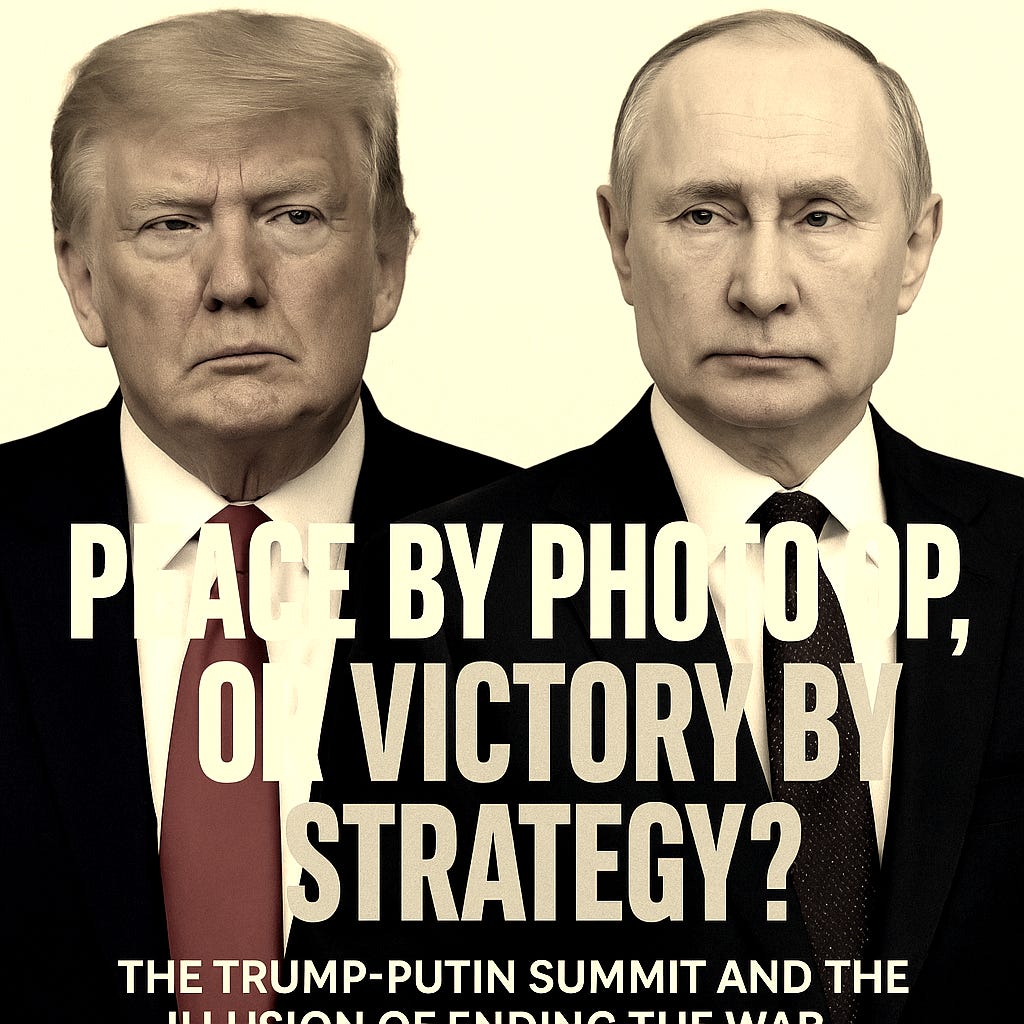
Into this vacuum steps Donald Trump, offering clarity by way of spectacle. On Friday, he is scheduled to meet with Vladimir Putin at Joint Base Elmendorf–Richardson in Alaska—the first time a U.S. president will host Putin on American soil since 1988.
Framed as a “listening exercise” and an effort to “end the war,” the summit begins with a private session (with only translators present), expands to include senior officials, and concludes with a joint press conference. Trump has stated that if no ceasefire or deal emerges, there will be no follow-up meeting.
The symbolism is striking—and jarring. A Cold War–era base on America’s frontier with Russia offers a stage for geopolitical theater. For Putin, it will be spun as validation. For Trump, it’s a campaign prop. For Ukraine, it may feel like betrayal.
The Real Risk: Substituting Optics for Outcomes
This summit could do more than fall flat—it could send a dangerous signal. Trump’s past solo meetings with Putin, such as the 2018 Helsinki summit, yielded little but gave Moscow propaganda victories. This time, with the war ongoing and global stakes higher, the cost of symbolic diplomacy is greater.
If the image of Putin standing beside a U.S. president on American soil becomes the headline, it could shift the narrative: from repelling an invasion to “resolving a dispute.” The deeper danger is not the handshake, but the illusion that peace can be conjured without consequences—that strength can be replaced by stagecraft.
The Strategic Fork Ahead
Trump’s summit reflects a broader indecision within the West. There are two plausible paths forward—neither easy, neither clean.
First, stay the course. This means sustained military and financial backing for Ukraine, continued sanctions on Russia, and strategic patience. It is costly, slow, and politically difficult—but it is the only path that does not reward aggression.
Second, pursue a negotiated settlement. But Putin’s current demands are maximalist: recognition of Russian control over occupied Ukrainian territories, Ukraine’s neutrality, and exclusion from NATO. Accepting them would legitimize conquest and embolden future aggressors.
So—How Does the War Actually End?
There are only three plausible outcomes:
Ukrainian Victory
Through sustained Western support, Ukraine regains its territory, weakens Russia’s military capacity, and secures its future on its own terms.A Frozen Conflict
The Korea model: a ceasefire without peace, territorial ambiguity, long-term instability. Russia keeps some land. Ukraine remains armed and wary.Collapse from Within Russia
Economic pain or political fracture destabilizes Putin’s regime. This is possible—but unpredictable and not a basis for strategy.
What’s clear is this: there is no fourth option. No shortcut, no photo op, no solitary summit will end the war without cost.
A Moment of Clarity—If Not of Peace
Trump’s Alaska summit may achieve little diplomatically, but it could force a reckoning. If it fails—as most expect—it might finally strip away lingering illusions. The war in Ukraine will not end through vague platitudes or symbolic meetings. It will end through resolve, leverage, and hard decisions: defeating Russia on the battlefield is the only true path to it.
When the stage lights dim in Alaska, the war will still rage. And the question will remain: is the West prepared to end it with strategy—or prolong it through spectacle?