


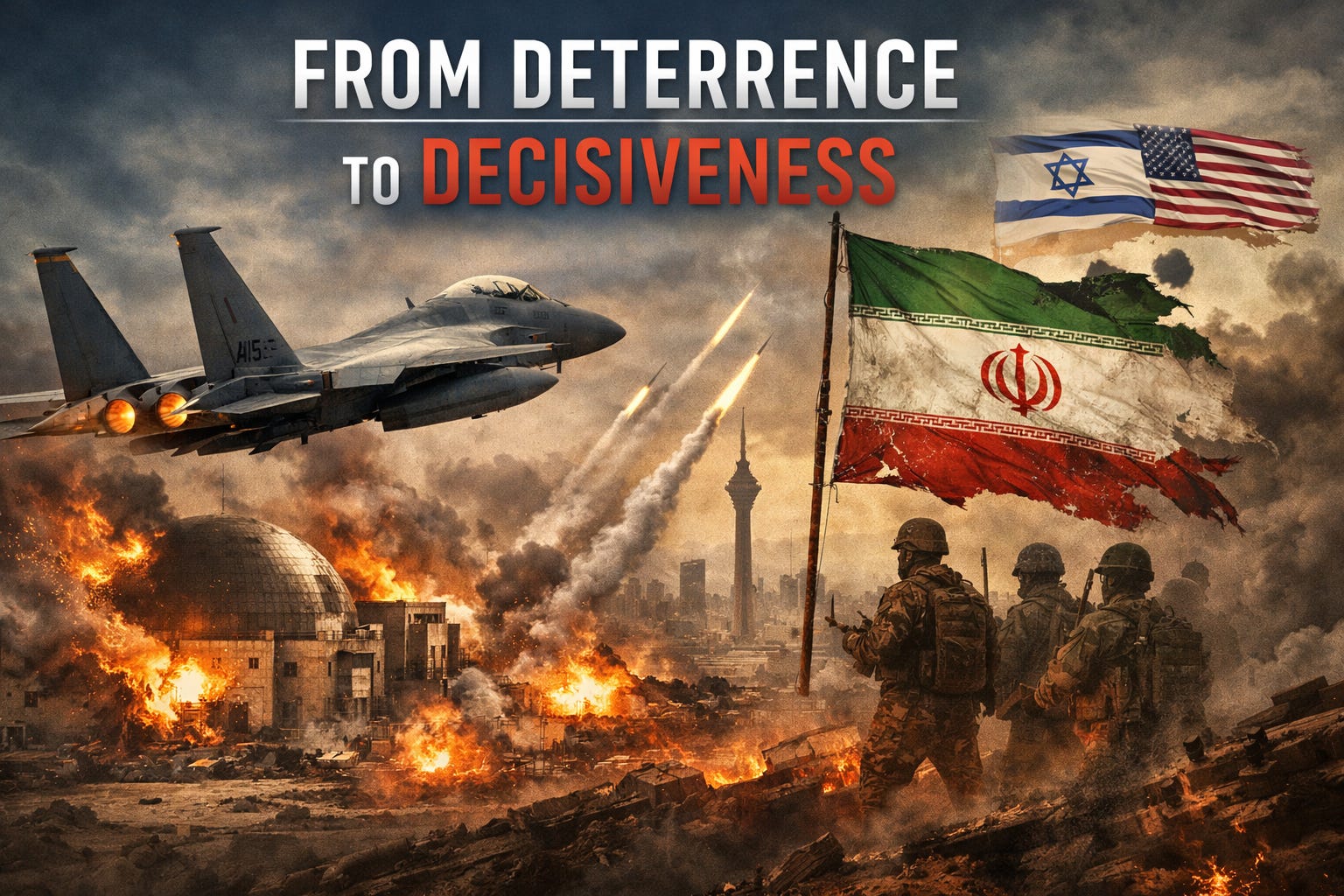
STRATEGIC TAKEAWAY: The fifty-year era of deterrence is over. We are now in the era of execution. This is no longer a debate about whether Iran’s nuclear ambitions must be stopped, but whether the United States has the discipline to shape and prevail in the conflict it has already entered.
The End of Strategic Ambiguity For nearly half a century, the American political establishment—Republicans and Democrats alike—held to one clear, non-negotiable principle: Iran must never be allowed to acquire a nuclear weapon. This was not a partisan preference. It was a baseline of American national security across ten presidencies.
That principle was settled long ago. What is no longer hypothetical is its enforcement. The “options” that sat on the table for decades are now being carried out on the ground in Operation Epic Fury.
With the shift from strategic ambiguity to strategic action, the question is no longer whether force will be used. That bridge has been crossed. The only question that remains is: toward what end?
As the conflict matures, the domestic conversation must mature with it. Much of the political and media class has defaulted to a shallow “pro-war versus anti-war” binary, as if strategy can be reduced to televised posture. That is not serious leadership. Once a nation is engaged, the obligation is no longer to perform opinion. It is to shape the outcome.
Shape the Endgame, Not Just the Critique What currently passes for debate in Washington is too often a sorting ritual: politicians positioning themselves for their preferred audience rather than engaging in serious statecraft. For leadership, particularly within the Democratic Party, this reflex toward distancing is a strategic error.
Engagement is the only way to influence the strategic horizon. A seat at the table is how lawmakers shape not only how force is used, but the purpose it serves. If elected officials want a voice in the outcome, they must move beyond commentary and take responsibility for the debate over authorization, funding, and the conditions of success. To obstruct the endgame through domestic friction is only to embolden the adversary at a moment of high-stakes transition.
Decisiveness Without Drift: Strategic decisiveness must not be confused with open-ended drift or indefinite nation-building. The objective is not to replicate the quagmires of the past, but to use disciplined force in service of a defined outcome: an Iran meaningfully less capable of threatening the world.
That requires recognizing a basic strategic truth: a mission can be clear without every metric being publicly fixed in advance. Some of the criticism about “unclear objectives” overlooks the advantage of preserving operational flexibility. Publicly rigid benchmarks can become traps—giving the enemy a target to survive, a narrative to manipulate, and Washington a set of political tripwires that can distort decision-making.
Strategic ambiguity at the operational level serves several purposes. It denies the IRGC a clear metric by which to measure endurance or claim victory. It allows policymakers to increase or reduce pressure in response to events and intelligence without being boxed in by a public checklist. And it preserves room to pursue the highest plausible outcome without prematurely narrowing the mission to the lowest politically defensible denominator.
That is why the administration should treat its highest aims not as rhetorical excess, but as a strategic ceiling. A serious strategy defines the best plausible outcome clearly enough that even an incomplete result leaves the world safer than the failed equilibrium of the past forty years.
The Five Pillars of the Strategic Ceiling
The U.S. strategy should be built around five interlocking pillars:
1. Nuclear Neutralization: The permanent dismantling of breakout capacity so that Tehran cannot rapidly assemble a nuclear device.
2. Military Degradation: The lasting reduction of the IRGC’s ability to threaten neighbors, destabilize the region, or endanger global energy corridors.
3. Regime Transformation: Supporting the emergence of a more moderate Iranian order, less inclined toward external aggression and internal repression.
4. Governance Pillar: Preparing for a technocratic transitional structure capable of filling any emerging power vacuum with domestic legitimacy and preventing state collapse.
5. Information Pillar: Treating unrestricted digital access for the Iranian people as a core strategic objective, empowering internal agency over the security apparatus.
The Strategic Horizon: The goal is not to humiliate a nation, nor to fracture a state. It is to dismantle the coercive machinery that has held an entire region hostage through proxy warfare, ideological export, and nuclear brinkmanship. Any serious endgame must distinguish between a regime that thrives on disorder and a population that has long borne the cost of its rule.
A post-regime Iran should not be viewed through the lens of a defeated adversary, but as a potential anchor in a new regional security architecture. By integrating a reoriented Tehran into an Abraham Accords 2.0 framework—linking Israel and key Arab partners—the United States can help transform a chronic source of instability into a constructive regional actor.
If America is already in the contest, seriousness requires more than criticism. It requires the clarity to define the ceiling, the discipline to maintain operational ambiguity, and the resolve to ensure that when the dust settles, the threat is not merely paused, but permanently diminished.