


A society that confuses protest with purpose cannot remain free.
Why America’s Youth Crisis Is Cultural, Not Clinical
The 94-Percent Mirror
When the Los Angeles Times reported that 94 percent of young Californians say they struggle with mental-health issues (LA Times, Oct. 21, 2025), the details were staggering.
Nearly all of those reporting poor mental health were youths of color, one-quarter identified as LGBTQ+, and their top stressors weren’t personal at all—they were systemic: gun violence, housing costs, discrimination, and climate change.
The state that promises opportunity has left its youth crushed beneath the anxiety of keeping that promise alive.
If nearly every young person in the most progressive, prosperous state in America feels mentally unwell, something deeper than access to therapy is broken.
This is not merely a health statistic—it’s a mirror held up to a civilization losing its balance.
California has poured billions into counseling programs, wellness curricula, digital-detox campaigns, and youth initiatives funded through its Mental Health Services Act.
Yet anxiety and depression are surging faster than the services meant to relieve them.
What we are seeing is not a failure of psychiatry but of society itself—a culture collapsing under the weight of its contradictions, promising salvation through empathy while delivering exhaustion through chaos.
Inflated Diagnosis, Deflated Resilience
It’s fair to ask whether the bar for what counts as a “mental-health issue” has sunk too low.
When ninety-four percent of young people say they are struggling, perhaps we’ve medicalized the normal turbulence of human life.
Not every bout of anxiety or sadness is an illness; sometimes it’s the natural friction of growing up in a confusing world.
But that, too, is revealing: if we’ve turned ordinary discomfort into pathology, it suggests we’ve lost faith in resilience itself.
We no longer teach our children that difficulty is formative—we teach them that it’s diagnostic.
The line between being challenged and being damaged has blurred so completely that endurance now feels abnormal.
That same impulse now defines our public life.
We’ve expanded “mental health” the way we’ve expanded “moral harm”: every offense, every policy setback, every perceived inequality is treated as a trauma.
This therapeutic politics leaves no room for endurance, only escalation.
We react, we denounce, we demand validation, and we call it activism.
So whether the number reflects real illness or inflated sensitivity, the signal is the same: we are producing fragility at scale, and mistaking fragility for virtue.
This therapeutic mindset doesn’t stay personal; it has fundamentally reshaped our public square. We have moved from a politics of persuasion to a politics of pain, and protest has become its primary stage.
The Dream That Became a Pressure Cooker
For half a century, California has been America’s moral frontier—environmental vanguard, social-justice laboratory, digital utopia.
Its ideals were luminous: equity, sustainability, inclusion.
But ideals, when multiplied without order, become demands.
Today’s youth inherit not one mission but dozens: save the planet, dismantle injustice, champion every cause, and do it all publicly, perfectly, online.
Behind the sunshine rhetoric lies a darker arithmetic—rising homelessness, dislocated families, schools drowning in behavioral crises, and the omnipresent pressure to care about everything.
The result is moral overload—an entire generation suffocating beneath the weight of adult confusion. They were promised progress; they got a pressure cooker.
The LA Times survey itself reads like a political agenda turned inward: housing affordability, racism, climate change, gun violence. These are genuine concerns, yet their accumulation in the psyche of sixteen-year-olds shows how adults have transferred the full burden of unsolved politics onto the young. We’ve taught them not only what to worry about, but that worry itself is virtue.
Every disagreement is a crisis; every opinion a moral test. The young no longer inhabit a stable moral landscape—they traverse a minefield of competing virtues, unsure which one will explode next. When ideals become infinite but meaning finite, the mind buckles.
Protest as Performance
That fracture burst into view during the recent “No King” protests against Donald Trump.
Ostensibly a defense of the rule of law, they unfolded as carnivals of grievance.
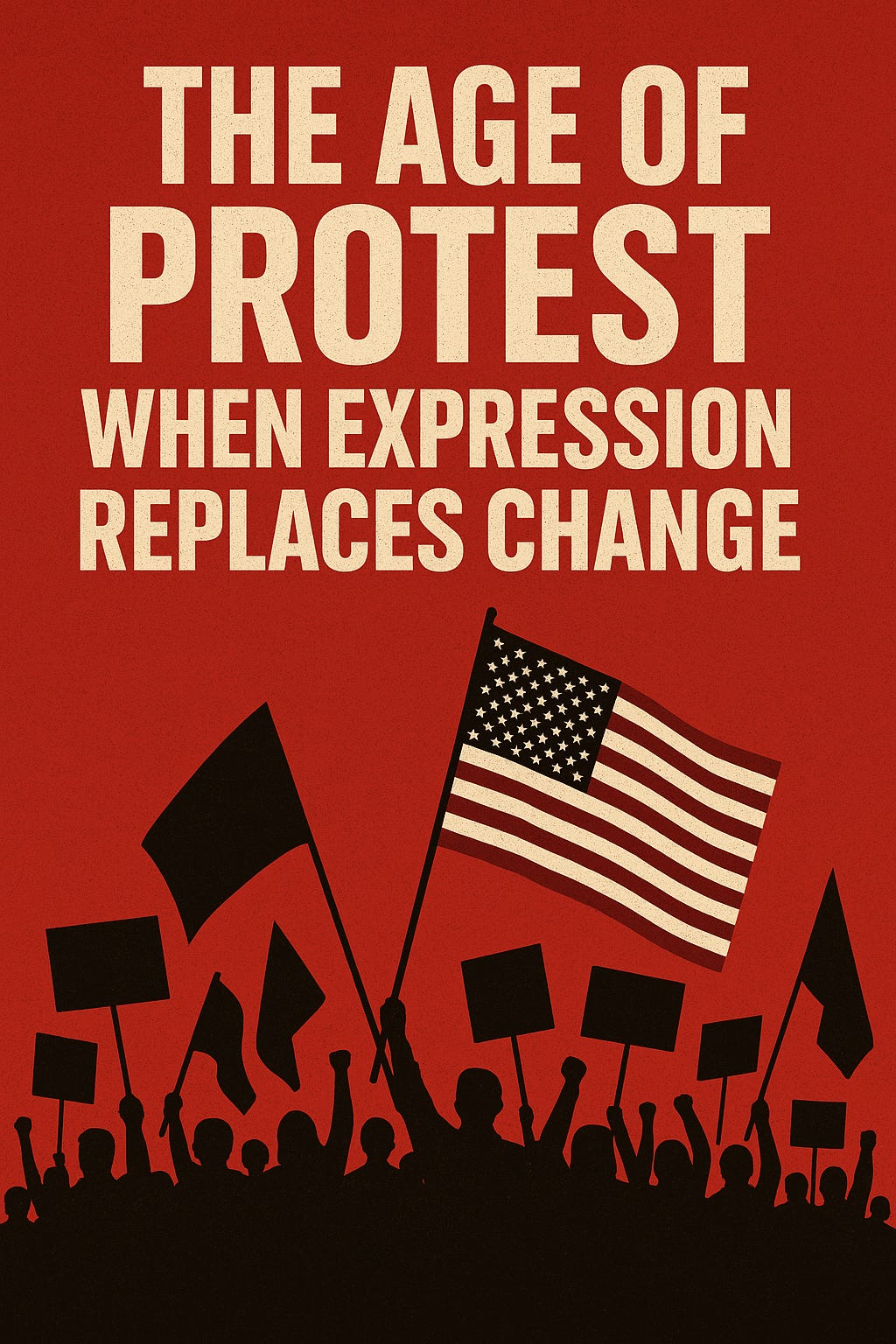
The streets were a collage of banners—Mexican, Palestinian, LGBTQ, anarchist—each a legitimate story of struggle, yet together a portrait of disunity. The one flag scarcely visible was the American flag, the emblem of the Constitution that guarantees the right to protest in the first place.
It was a telling tableau. What began as a political statement about executive power devolved into a pageant of competing identities, each asserting pain louder than purpose. This is what protest has become: an act of performance rather than persuasion, catharsis without consequence.
We march, chant, livestream, and post, convinced that visibility is victory.
But when every demonstration is about expression and none about legislation, protest stops being civic action—it becomes entertainment.
In a healthy republic, protest is a means to shape law; in ours, it has become an escape from the responsibility of governing. We raise placards not to deliberate, but to display ourselves—to prove moral awareness rather than achieve moral outcomes.
It’s politics as theater, and like all theater, it ends when the curtain falls—leaving nothing changed but the fatigue of the actors.
When Activism Replaces Citizenship
Citizenship is the hard discipline of building, maintaining, and improving institutions. It requires patience, compromise, and tolerance for imperfection.
Activism, as practiced today, demands none of these things. It rewards immediacy, outrage, and aesthetic posture—the appearance of engagement without its cost.
We have taught our young that to be good is to be indignant, that moral authority lies not in participation but protest. Legislators deliberate; activists disrupt.
One governs; the other emotes. Because governance is tedious while outrage is thrilling, the culture naturally tilts toward the latter.
This permanent state of mobilization corrodes democracy from within.
A nation cannot live in perpetual opposition to itself. When dissent becomes a lifestyle rather than a civic duty, institutions decay and politics turns to spectacle. The crowd replaces the Congress.
The Psychological Toll
The human mind is not built to sustain constant alarm.
A child raised amid unending crisis—climate apocalypse, racial reckoning, gender warfare, economic collapse—learns that the world is a battlefield and that adulthood offers no peace. Anxiety ceases to be a disorder; it becomes the baseline of existence.
The 94-percent figure is not an isolated California oddity—it’s a reflection of what’s happening almost everywhere. From New York to Seattle, from London to Paris, young people report record levels of loneliness and despair.
We diagnose them as if the problem were internal, when in fact they are the most sensitive instruments of a broken civilization. They feel what the rest of us have learned to numb: the hollowness of constant conflict, the fatigue of infinite causes, the loss of collective purpose.
As the LA Times survey confirms, the heaviest anxiety now comes from macro-level fears—climate, housing, violence—issues no individual adolescent can control. When adults turn every debate into moral combat, children inherit the noise. When politics becomes theater, the audience becomes anxious.
Even in an era of abundance, we are raising a generation that feels impoverished—spiritually and psychologically.
From Despair to Defiance — The Lone Wolf Parallel
While most of this civic despair is internalized—leading to the anxiety and depression the LA Times captured—it doesn’t always stay that way. When that same despair finds no outlet and no purpose, it can curdle into rage. What begins as civic exhaustion doesn’t always end in apathy.
Sometimes it mutates into rage.
In my Lone Wolf Series, I wrote about how many so-called “political” attacks in America are not coherent ideological crusades but personal implosions dressed in political language. They are symptoms of despair seeking legitimacy through violence.
The culture that glorifies grievance and perpetual outrage gives those collapses their costume. When belonging vanishes and ideology becomes therapy, the unstable find in extremism the illusion of purpose they’ve lost elsewhere.
The “lone wolf” is not born in a vacuum; he is the extreme expression of a society that mistakes fury for conviction and visibility for value.
That’s why the line between protest and pathology is thinner than we admit.
A culture that trains people to live in emotional overdrive cannot be shocked when some cross the boundary from performance to bloodshed.
Political violence, in that sense, is not imported—it’s homegrown despair seeking an audience.
Reclaiming Allegiance
There was a time when protest itself was an act of allegiance.
Marchers carried the American flag not as nationalism but as a pledge: we are holding the nation to its own ideals. The flag symbolized unity through accountability.
Today, that understanding has vanished. For many, the flag itself has become a symbol of the nation’s failures, representing the very system they feel has betrayed them. But this is a tragic confusion of the symbol with the state. To abandon the flag is to cede the very definition of patriotism to those one opposes.
We no longer distinguish between criticizing our country and abandoning it. We wave every banner but our own, as though shared citizenship were suspect.
When I raise the American flag, I do so not to glorify government but to affirm allegiance to the Constitution—to the covenant that binds free citizens under law.
That is the flag that belongs in every protest about justice, immigration, equality, or governance.
It represents the system that allows dissent to matter. To protest under other flags alone is to fragment the republic into tribes of grievance; to protest under the American flag is to demand that our republic live up to its promise.
Allegiance does not mean obedience.
It means shared responsibility—accepting that freedom requires stewardship.
Democracy cannot survive without affection for itself.
When every protest tears at the flag instead of strengthening its fabric, liberty becomes impossible to sustain.
A Call to Renewal — or the Warning Ahead
If 94 percent of our youth are mentally distressed, the remedy is not merely more therapists but fewer contradictions.
We must quiet the cultural noise that tells them the world is ending every hour.
We must teach that progress is not perpetual demolition but disciplined repair.
That civic disagreement is not war but work.
That freedom is not a performance—it is a responsibility.
The work begins with adults. We must model steadiness where they see hysteria, coherence where they hear chaos. We must remind them that citizenship is not inherited by birth but renewed by conduct.
The American experiment—still unfinished, still magnificent—depends on our willingness to govern ourselves rather than perform our passions before an audience.
Because if we fail, the warning is clear:
A society that cannot distinguish protest from purpose will lose both.
We will raise children fluent in outrage but illiterate in liberty, citizens of a republic they no longer believe exists.
Mental-health clinics will overflow, not because of chemical imbalance, but because despair will have become the normal condition of civic life.
The path forward is not glamorous. It begins in classrooms that teach civics instead of slogans, in homes where disagreement doesn’t mean division, in newsrooms that value truth over trend, and in streets where protest once again aligns with policy rather than performance.
Only then can the flags of our many identities fly together beneath one banner—not in submission, but in solidarity.
If we rediscover that discipline, the 94 percent will fall.
If we do not, no amount of counseling will save us from the collapse of meaning we have created.
Sources
Los Angeles Times, “California young people are struggling with anxiety and stress, study finds,” Oct 21 2025
UCLA Center for Health Policy Research, California Health Interview Survey (2019–2023)
California Mental Health Services Act, Proposition 63
The LA Trust for Children’s Health, Youth Mental Health Access Survey