


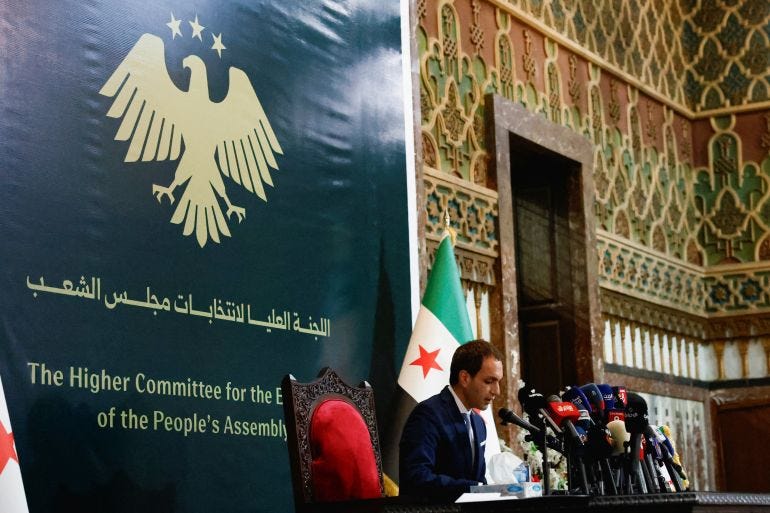
The recent op-ed “The First Election in the New Syria: A Missed Opportunity” raises important and valid concerns about the concentration of power under President Ahmed al-Sharaa and the limitations of Syria’s first parliamentary elections since the fall of Bashar al-Assad. The authors are right to point out the dangers of executive dominance, the need for genuine separation of powers, and the imperative of inclusion in political life.
Yet while I share their democratic aspirations, I differ on one essential point: the expectation that Syria could immediately achieve full, unfettered democratic representation after fourteen years of war, fragmentation, and institutional collapse is simply impractical.
From Collapse to Process
Syria today is a country emerging not from reform, but from ruin. It remains territorially divided, its institutions exhausted, its people traumatized and divided over sectarian and ethnic lines. In such conditions, the notion of instant democracy is more aspirational than operational.
Political systems require trust, habit, and stability—three things Syria has not yet regained.
Seen in that light, these elections—however imperfect—represent an experiment in reintroducing Syrians to the mechanics of governance. They are not, as critics claim, an end in themselves or a disguised authoritarian consolidation, but a transitional rehearsal in participation and political management.
Democracy does not materialize by decree. It grows through repetition, compromise, and learning. Even flawed elections can teach citizens how to question, organize, and participate. They can familiarize both the governing and the governed with the idea of peaceful political competition—something Syria has not experienced in half a century.
The Imperfect Path of Transitions
All post-conflict transitions begin this way. History offers countless examples. Iraq’s early elections were marred by boycotts and violence, yet they introduced a new political vocabulary. Tunisia’s first transitional government was criticized for centralization, but it helped lay the groundwork for pluralism. Even Western democracies, in their origins, tolerated power imbalances while developing institutional checks over time.
Syria’s transitional period will not be different. To insist on immediate perfection is to risk paralysis—to demand purity before progress. That approach may satisfy ideals but rarely builds nations.
The challenge, therefore, is not to reject this election, but to use it as a stepping stone. The flaws identified—presidential appointments, vague candidacy restrictions, symbolic quotas—should become the basis of reform discussions. Civil society, legal experts, and the international community must push for amendments, transparency, and independent monitoring electoral bodies, rather than declaring the entire process illegitimate.
Learning Before Legislating
The authors are correct that the legislature must ultimately possess full lawmaking authority and the power to oversee the executive. But Syria cannot leap from dictatorship to parliamentary democracy without first building institutional muscle. At this stage, even a limited legislature, one that debates, questions, and records dissent, can begin to normalize accountability.
What matters most is whether this transitional parliament evolves—or ossifies. If it remains a mere extension of the presidency, the critics will be vindicated. But if it grows into a forum where genuine debate begins, even within boundaries, then it will have achieved more than cynicism allows.
Toward a Realistic Vision of Democracy
Syria’s path forward must balance idealism with pragmatism. The democratic model worth pursuing is not the immediate replication of Western systems, but a Syrian model—gradual, inclusive, and suited to a country still healing from war.
The international community should support this process with guidance, technical assistance, and benchmarks—not by condemning every imperfect step as a failure. The goal is not to stage a flawless election, but to restore a functioning political life that Syrians can shape and refine over time.
Conclusion
Syria’s first election in the post-Assad era was far from free or fair. But it was not meaningless. It was a mirror held to a society rediscovering the practice of governance after years of chaos. The true test lies not in what happened on October 5, but in what follows—whether this experiment in controlled participation evolves into a culture of accountability and reform.
Democracy cannot be imported or imposed; it must be practiced, learned, and earned. This election, for all its flaws, may be the beginning of that long and necessary education.