


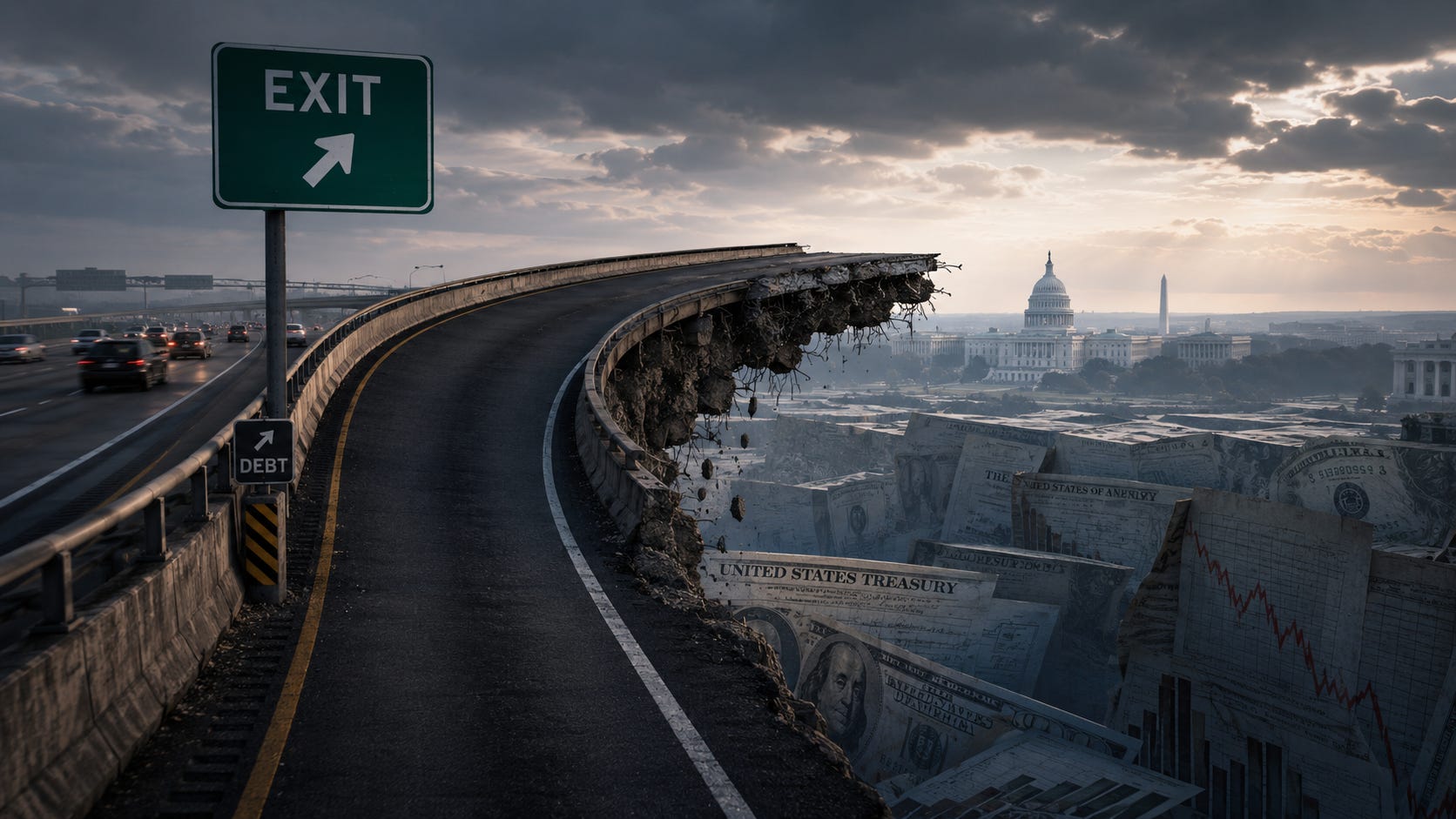
At the end of March 2026, debt held by the public stood at $31.27 trillion, while nominal GDP over the prior twelve months was $31.22 trillion. For the first time since World War II, debt held by the public now exceeds the entire annual output of the American economy.
A country does not collapse because a spreadsheet ratio crosses a specific line. The issue is not how high the debt is, but whether there is any credible way out.
In 1945, the path forward was visible: demobilization, a booming population, industrial expansion, and a sharp reset in wartime spending. Today, debt is no longer a temporary emergency measure; it is increasingly the financing mechanism for the day-to-day operations of government.
What is missing is a politically credible bridge from current debt levels to future stability.
The Missing Bridge
The postwar debt burden was heavy, but it had built-in relief. A young population and a manufacturing base ready to scale allowed the economy to grow out of its obligations. That backdrop no longer exists.
The federal government is now borrowing heavily to sustain ordinary operations. The Congressional Budget Office projects a $1.9 trillion deficit for fiscal year 2026, with debt held by the public expected to reach 120% of GDP by 2036.
This is not a temporary imbalance. It is a structural gap between what the government promises and what it actually collects.
The Debt Spiral
There are only a few ways back.
Growth is the hope, but it’s uncertain.
Fiscal correction — spending restraint, tax increases, entitlement reform, or some combination of the three — is possible, but politically avoided.
Inflation is the default option that requires no vote.
This is the “no-bridge” scenario. If interest rates remain just one percentage point above current projections, debt would rise by an additional $3.5 trillion over the next decade. Interest costs alone could reach $2.7 trillion by 2036.
This is how the spiral works: more debt raises interest costs, higher interest costs widen deficits, and larger deficits require still more debt.
Size matters less than trajectory. The debt is moving faster than the economy behind it.
Inflation as the Exit Nobody Voted For
When a country borrows in its own currency, the risk is not always that it will fail to pay. The risk is what that payment will be worth.
As debt grows, pressure on the Fed begins to build. The Federal Reserve’s formal mandate is price stability and maximum employment. But a heavily indebted government creates pressure — often implicit rather than announced — to keep interest rates low enough to prevent financing costs from becoming politically unbearable.
This is what financial repression looks like.
By allowing inflation to outpace interest rates, or by tolerating inflation longer than it otherwise would, the real value of government debt is slowly eroded. The burden shifts quietly onto savers, retirees, and wage earners.
Call it what it is: an inflation tax that was never explicitly approved.
The Institutional Safety Valves
Why has there been no immediate break?
Because the United States possesses safety valves that most countries do not.
First, it borrows in a currency it controls. Nominal obligations can always be met. We can print dollars, but we cannot print purchasing power.
Second, the United States benefits from the “cleanest dirty shirt” dynamic. Treasury markets remain deeper and more liquid than any global alternative. Capital continues to flow into the dollar system, not always because the United States looks strong, but because the alternatives look weaker.
Third, the dollar remains the world’s primary reserve currency. That status creates persistent demand for Treasuries and allows the United States to run deficits for longer than ordinary countries could sustain.
But these are not solutions. They act as safeguards—but they also encourage complacency.
They extend the timeline, but they also deepen political complacency. Because there is no immediate market revolt, policymakers mistake tolerance for permission. The absence of a crisis makes the underlying problem easier to ignore.
The Technology Wildcard
The optimistic case rests on a productivity miracle. If artificial intelligence, energy abundance, and other technological breakthroughs push growth significantly higher, the debt burden becomes easier to carry.
But that outcome is not guaranteed. And even if it happens, it may not translate cleanly into fiscal relief.
For technology to save the balance sheet, it must generate enough taxable growth to outrun compounding interest on an already enormous debt stock. If AI disrupts the workforce, depresses wages in parts of the economy, or increases demand for public support, the government may end up spending much of its technological dividend on an expanded safety net.
In other words, the same forces that expand output may also expand obligations.
Productivity gains are uncertain. Interest payments are not.
The Final Tally
Crossing the 100% debt-to-GDP threshold does not trigger a crisis by itself. But it is a warning sign of a more fragile fiscal position, where the least visible adjustment — currency devaluation — can become the most politically convenient.
The real issue is whether the political system still has the capacity to choose a different path: growth, reform, and some degree of restraint before inflation becomes the default release valve.
America still has time. What it does not yet have is a plan. If no bridge is built, the debt will be serviced one way or another.
The only question is who pays.