


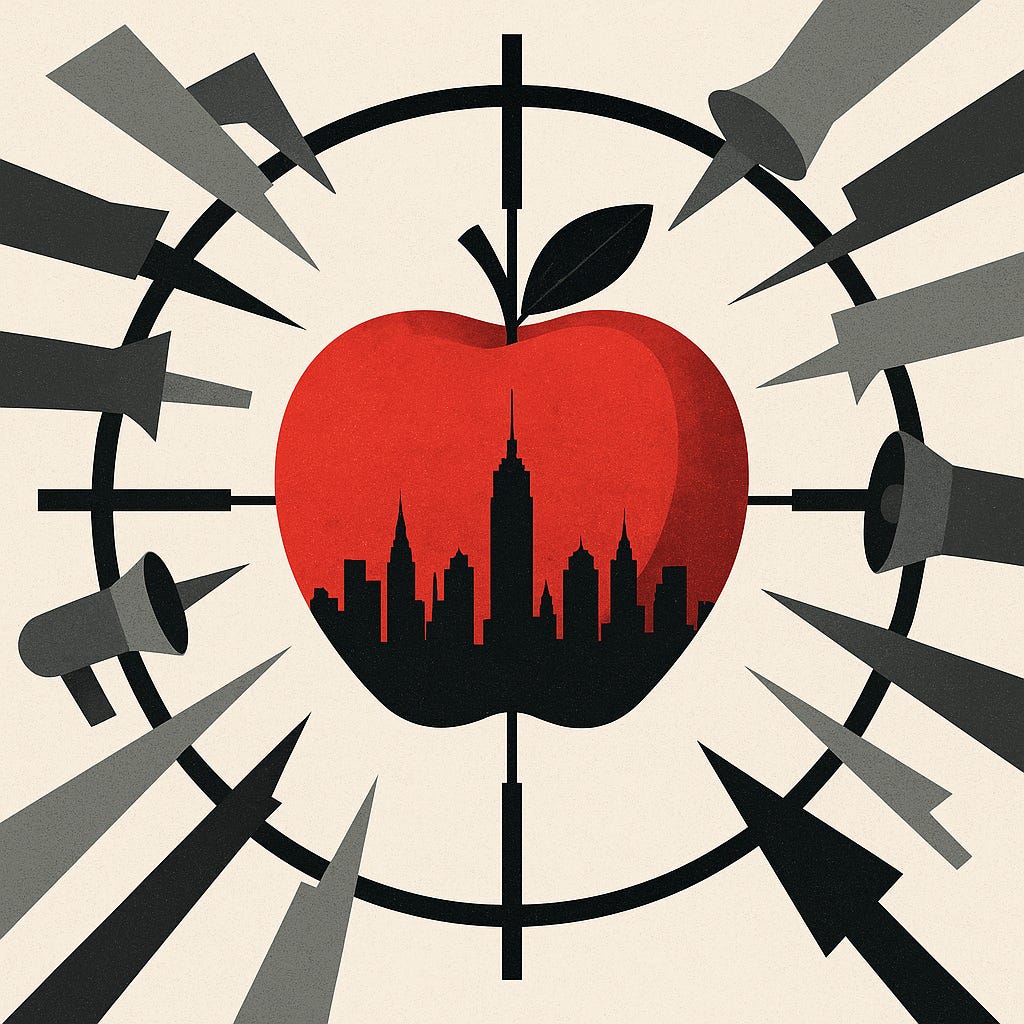
Bernard-Henri Lévy’s recent Wall Street Journal essay, “Europeans Watch New York’s Mayor’s Race With Fear,” is not just alarmist; it’s a symptom of a deeper malaise in public discourse. The French philosopher casts Zohran Mamdani, a 34-year-old progressive candidate for New York City mayor, as an existential threat to Jews and to democracy itself. Why? Because he has spoken out against Israel’s war on Gaza and in favor of Palestinian statehood.
Let’s be clear from the outset: this piece does not advocate for Mamdani’s governance style or endorse his policy agenda. His youth, limited executive experience, and ambitious platform deserve scrutiny — that’s part of any serious campaign. What this essay challenges instead is the smear campaign that has come to define elite commentary on candidates who dare criticize Israel’s conduct.
When Conscience Is Branded as Hate
Lévy’s op-ed doesn’t read as analysis; it reads as moral panic dressed up as philosophy. In his framing, opposition to Israel’s military actions equals hatred of Jews, and solidarity with Palestinians equals sympathy for terrorists. It’s a false and dangerous equation.
Millions of people across the world — including countless Jews — have condemned Israel’s devastation of Gaza not out of prejudice but out of conscience. They have watched the deliberate starvation of civilians, the flattening of neighborhoods, and the bombing of hospitals. When even former Israeli Prime Minister Ehud Olmert calls these actions war crimes and crimes against humanity, it’s time to stop branding critics as extremists and start confronting the reality those critics describe.
The Erosion of Moral Credibility
Israel’s loss of moral standing is not the result of antisemitism but of its own conduct. Decades of occupation, illegal settlement expansion, and an open-air siege of Gaza have eroded the moral legitimacy once associated with the promise of a democratic homeland. The tragedy is compounded by the weaponization of Jewish suffering to justify Palestinian suffering.
Being the victims of the Holocaust does not absolve any state of responsibility under international law. The moral lesson of “never again” is universal or it is meaningless.
The American Mirror
Lévy’s alarm says less about Mamdani than it does about America’s shifting moral center. For decades, unquestioning support for Israel was treated as a political necessity. But younger Americans, more globally connected and more skeptical of inherited narratives, now view Gaza not as a distant conflict but as a moral emergency.
This change frightens the political establishment, which mistakes the erosion of blind loyalty for the erosion of Jewish safety. Yet the opposite is true: moral consistency, not selective outrage, protects minorities. Jewish security and Palestinian freedom are not opposites; they are intertwined. Both depend on justice.
The Backlash Against the Fear Machine
Ironically, attacks like Lévy’s have only made Mamdani stronger. By trying to portray him as a menace, they turned him into a symbol of integrity in the face of bullying. New Yorkers — famously allergic to being told what to think — saw through the smear. His growing support is less a movement of ideology than one of exhaustion: a public tired of moral blackmail and of those who confuse defending Israel’s policies with defending Jewish identity.
Let it be clear again: supporting Mamdani’s right to speak truthfully about Gaza is not the same as endorsing his policies or his capacity to govern. His candidacy, like any, deserves critical evaluation. But none of that justifies the hysteria that frames empathy for Palestinians as antisemitism.
Mamdani’s rise tells us less about him than about the world around him — a world disgusted by double standards, tired of intimidation, and ready to call things by their real names. His popularity isn’t a revolution of ideas so much as a rebellion against fear. And the more the establishment reaches for its old playbook of smears and sanctimony, the more irrelevant it becomes.
A Crisis of Courage
If New York elects a mayor who refuses to sanitize occupation or genocide, that won’t mark democracy’s decline; it will mark its renewal. The real threat to pluralism isn’t a young progressive with empathy for Palestinians — it’s the industry of fear that insists empathy itself is dangerous.
New York doesn’t need another mayor who sees foreign policy through a donor’s lens. It needs leaders who understand that moral courage begins at home: the courage to speak for the powerless, even when it’s unpopular.