


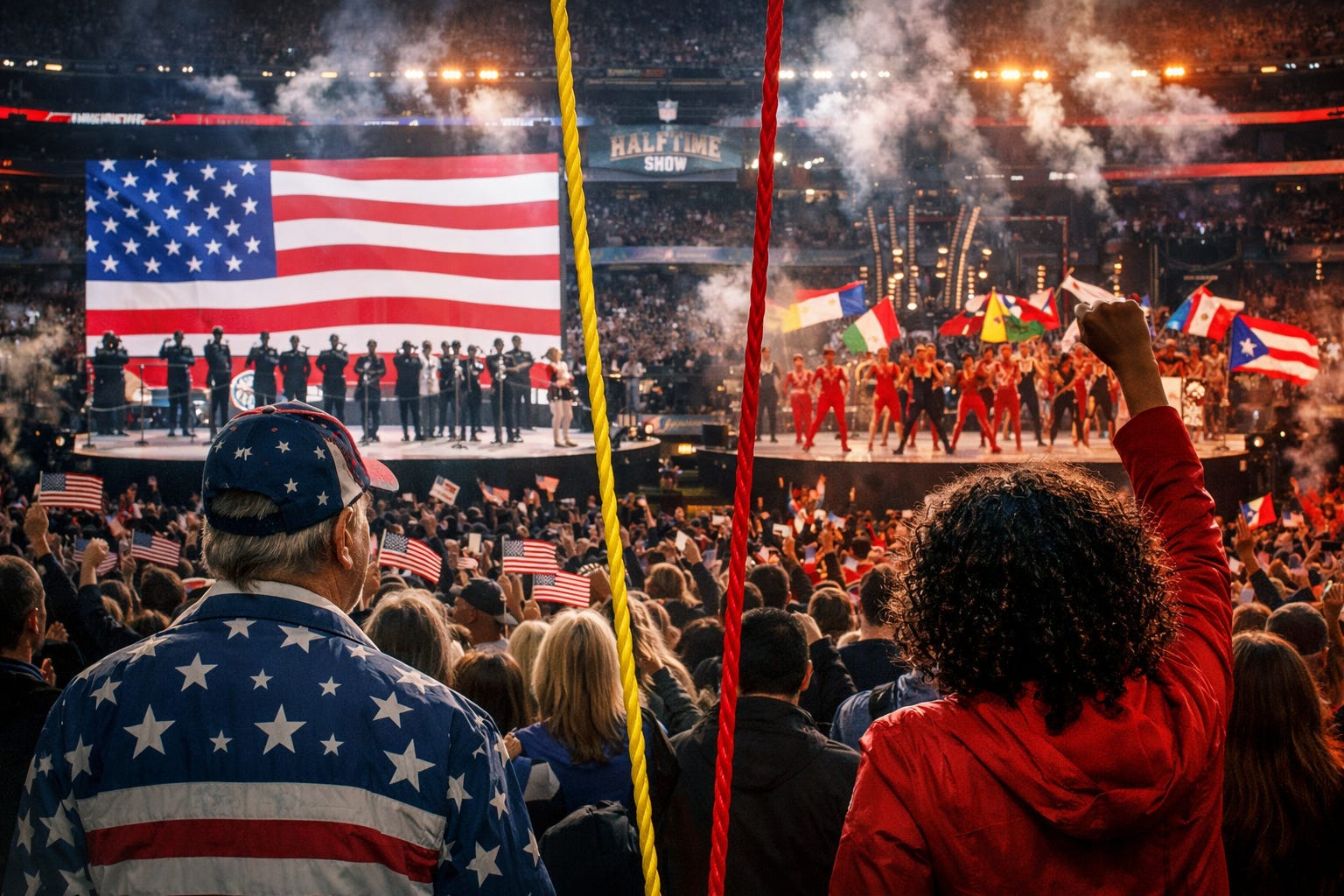
The Monday-morning debate about the halftime show is already predictable: one side calls it divisive and ideological, the other calls it progress and representation. But both sides miss the deeper shift. The unease isn’t simply about language or culture; it’s that the Super Bowl—one of the last national “common room” rituals—no longer feels like a shared moment. This isn’t about any language or culture; it’s about what we’re turning shared rituals into.
A diverse country doesn’t stay coherent by winning arguments in every space. It stays coherent by protecting a few shared spaces where we can simply be together. That’s why the Super Bowl matters beyond football: it remains one of the only events that still pulls a cross-section of Americans into the same cultural moment without requiring them to adopt the same politics.
When that space is repurposed for instruction—when inclusion shifts from celebration to correction—the ritual stops functioning as a ritual. The audience is no longer simply watching; it is being positioned. And people do not become more generous when they feel managed.
Worse, this dynamic doesn’t unify; it escalates. If one side demands constant revision to feel pride, the other side will soon demand constant restoration. The ritual becomes a tug-of-war over whose America gets to be displayed—and whose America must sit quietly and be instructed. That is how you institutionalize division while claiming to heal it.
The more revealing shift, however, is not the performance itself, but the reaction to it. The real story isn’t that halftime got political—it’s that we’ve created a culture where some people experience patriotism only after a national ritual performs symbolic self-revision. For some people, the ritual is not claimable as “American” until it performs a visible act of self-correction.
This reveals a conditional patriotism. It suggests that for some, love of country is a transaction: I will embrace the home only when the home performs the version of itself that I prefer.
We need fewer moments that function as verdicts and more that function as bridges. If we can’t protect even one night—one ritual, one mass gathering—from becoming a seminar, then the lesson we’re really teaching isn’t history.
It’s that we no longer know how to be together.